
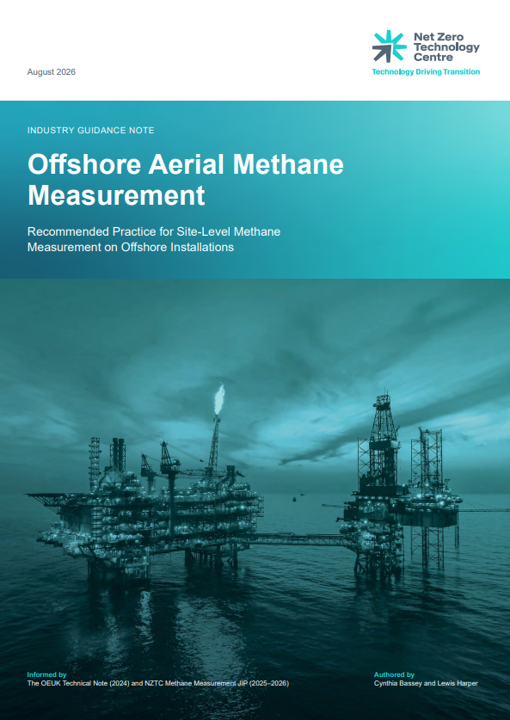
Offshore Aerial Methane Measurement: Industry Guidance Note
At a glance
Recommended Practice for Site-Level Methane Measurement on Offshore Installations
Site-level (top-down) methane measurement is foundational to OGMP 2.0 Level 5 reporting, but offshore methods have remained unregulated and inconsistently applied. Informed by the recommendations of the 2024 OEUK Technical Note, the NZTC Methane Measurement JIP (BP, CNOOC, Harbour Energy, Ithaca Energy, Serica, Shell; Aeromon, Flylogix, SINTEF Ocean; November 2025) generated field-based evidence and practical lessons to support the ongoing development of industry guidance. This guidance note distils those lessons into seven practical recommendations for offshore aerial methane measurement.
Key Highlights

Industry-led collaboration
Six UKCS operators and three measurement providers contributed to the learning captured in this guidance note.

Field-validated insights
Recommendations are informed by a multi-vendor trial undertaken at Ithaca Energy’s Captain assets.
Supports OGMP 2.0
Provides practical learning relevant to site-level methane measurement and Level 5 reporting requirements.
Industry-led collaboration
Six UKCS operators and three measurement providers contributed to the learning captured in this guidance note.
Field-validated insights
Recommendations are informed by a multi-vendor trial undertaken at Ithaca Energy’s Captain assets.
Supports OGMP 2.0
Provides practical learning relevant to site-level methane measurement and Level 5 reporting requirements.
Access the Guidance Note
Provide your details below to access the full guidance note
Key Takeaways from the Guidance Note
- 1
Understand the Asset
Understand the Asset
Know the emissions profile and operating state before you fly. - 2
Minimise Wind Wake Effects
Minimise wake effects while maintaining a detectable and representative methane plume.
- 3
Bound the Plume
Capture the plume above, below and across its full extent.
- 4
Use the Right Instrument
Match instrument capability to the measurement challenge.
- 5
One flight, one flux plane
Complete a flux plane measurement within a single continuous flight wherever practicable.
- 6
Prioritise Quality over Quantity
Use fit-for-purpose measurements rather than simply increasing measurement count.
- 7
Reconcile top-down with bottom-up
Interpret measurements alongside inventories and source-level data.
About the Methane Measurement JIP
The NZTC Methane Measurement JIP brought together BP, CNOOC, Harbour Energy, Ithaca Energy, Serica Energy and Shell, alongside measurement providers Aeromon, Flylogix and SINTEF Ocean. The programme generated field data and practical lessons to support the development of offshore methane measurement best practice.