
NEWS & INSIGHTS | article
Talent in north-east is the key to success
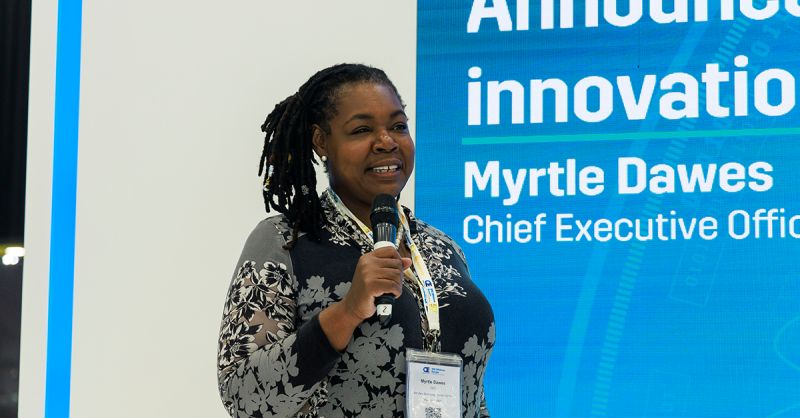

Myrtle Dawes
Myrtle Dawes is Chief Executive Officer of the Net Zero Technology Centre where she leads the development of technology for a net zero energy industry.
She is a non-executive board member of FirstGroup, a non-executive director on the Aquila European Renewables plc board, an advisory board member for the Association of Black and Minority Engineers and sits on the Technology Leadership Board.
A Chartered Chemical Engineer, Myrtle is an established leader with extensive experience in the energy sector both in the UK and overseas. Respected as a prominent voice on the energy transition, she began her career 30 years ago as an offshore engineer for BP, before delivering on leadership roles in engineering, project management, technology and digital transformation. Myrtle’s passion for innovation and technology galvanises her colleagues, government and industry to take action and push boundaries.
Myrtle holds a Masters in Chemical Engineering and Chemical Technology from Imperial College. She is a Fellow of the Institute of Chemical Engineers, Fellow of the Energy Institute, Fellow of the Forward Institute and Honorary Fellow of the Association of Project Managers.
In 2017, Myrtle received recognition for her contribution to business, having featured in Breaking the Glass Ceiling and being selected as one of 100 Women to Watch in the Cranfield FTSE Board Report 2017. In 2021 she was recognised by TE:100 as one of the Women of the Energy Transition.
Myrtle has two children and in her spare time studies mathematics, is a keen cat lover, and gamer.

Reflecting on my career journey that began years ago, there’s been an enduring stream of hope and optimism following the oil price crash of 2014 .
The crisis hit the north-east offshore industry with devastating force, leading to tens of thousands of job losses and leaving a trail of uncertainty and hardship.
The impact stretched far beyond the rigs, shaking supply chains, export-dependent businesses, and local services like hospitality and transportation, leaving the region grappling with the fallout.
The oil and gas industry is cyclical, and with the rebound came diversification into clean, renewable technology. These efforts are starting to bear fruit as the issue of climate change and reaching net zero dominates the political agenda.
The people and skills in the north-east are key to unlocking the UK’s ambition to become a clean energy superpower. For decades, the offshore sector has been at the forefront of technological innovation, ensuring Aberdeen’s workforce makes an unrivalled contribution both locally and nationally.
As the North Sea basin matures, the transition away from fossil fuels is not only inevitable but essential for the future of our planet.
While this shift can cause anxiety, with fears of job losses and investment withdrawal, it also brings extraordinary opportunities.
A reimagined North Sea can lead the global drive to deliver the commitments of the Paris Agreement on climate change.
Yes, a huge amount of investment is required over the next 30 years, but this creates an incredible business opportunity that by 2050 could potentially contribute £125 billion per year to the UK economy, while supporting more than 230,000 jobs.
Floating offshore wind – the next frontier in the renewables revolution – has the potential to deliver £43 billion and 29,000 jobs alone.
But there are of course challenges to delivering this integrated energy vision.
Key to success will be collaboration, so the early signs from the new Labour government in Westminster are encouraging.
GB Energy will need to be a partnership if it is to achieve its goals.
The Net Zero Technology Centre (NZTC) in Aberdeen is uniquely placed to deliver immediate impact for GB Energy and make the ambition to be a clean energy superpower a reality.
We accelerate the route to net zero, unlock private investment in renewables, and build industry partnerships, tackling climate change and creating jobs – all led from Aberdeen and the north-east.
Our team are experienced former oil and gas, renewables, supply chain, innovation, technology and finance experts.
And we deliver test projects and demonstrations in live environments, bridging the gap between research and commercialisation.
To date, we have co-invested £430 million in nearly 350 research and technology development projects and has screened over 3,000 technologies.
Nearly 60 technologies have been commercialised and 69 clean energy start-ups have been accelerated, creating 440 jobs in north-east Scotland and safeguarding 1,000 more.
Internationally, significant moves have been made in the pursuit of new industrial policies suitable for the massive energy transition needed for a net zero world.
With the US Inflation Reduction Act and the EU Green Industrial Deal coming on top of China’s long-running activist industrial policy, the world’s largest economic blocs are positioning themselves for a very different type of economic competition.
By 2050, 35 per cent of necessary greenhouse gas reductions will depend on new technologies.
This presents a £15 trillion economic opportunity globally, and – if we compete – the UK stands to gain £158 billion, with Scotland adding £16 billion.
These figures could soar if the UK exports its homegrown tech innovations, many of which will come from the north-east.
At the same time, providing more support for adapting proven technology from the oil and gas sector to new energy production methods could lead to short-term emissions reductions, boost productivity, and enhance energy security.
With appropriate investment at pace, we can leverage and capitalise upon our existing capabilities to be the supplier of next generation, net zero energy technologies.
As Rachel Reeves, Ed Miliband and new Energy Minister Michael Shanks have recognised, public investment in research and innovation is how we can attract the private capital that will drive progress.
A flourishing supply chain, supported by a skilled engineering workforce like the one in Aberdeen, further enhances our capabilities.
Given the scale of GB Energy’s targets, we stand ready to help deliver significant results.
If GB Energy is to deliver for the north-east, as well as Scotland and the rest of the UK, there needs to be a successful job transition from oil and gas to emerging clean energy sectors.
This is achievable. For decades, the north-east has had a can-do attitude – let’s not lose sight of this extraordinary opportunity ahead of us.
The article was originally published in the Press & Journal on 26 September 2024.

Subscribe for the latest updates