

UK Energy Sector Digital Adoption: A Local and Global Comparison
The benchmarking analysis highlights how countries like Norway, Germany, USA, South Korea, Japan and Singapore demonstrate advanced digital maturity and integration within their energy sectors.
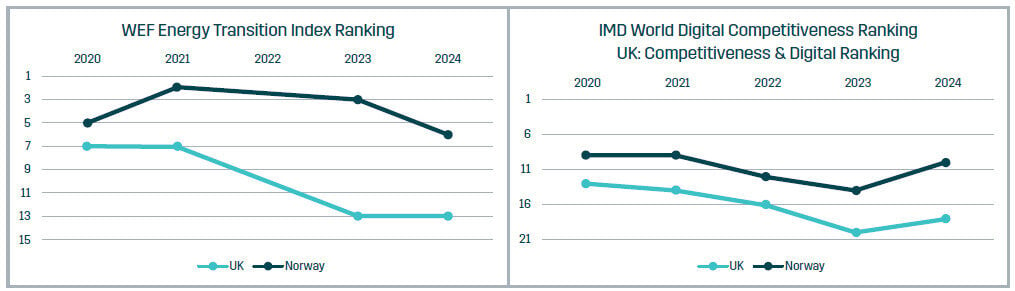
The Energy Transition Index (ETI) signifies those countries that are making significant progress on their current energy performance whilst also assessing readiness for transition. The Digital Competitiveness ranking (IMD) highlights those countries that are digitally mature in their adoption of technology, across all sectors.
Norway
Norway sets a global benchmark for digital integration in offshore oil and gas, using technologies like digital twins, AI-driven maintenance, and automation. Platforms such as NCS DataHub enable open data access for benchmarking, maintenance, and emissions tracking. Strong collaboration between operators, regulators, and researchers accelerates innovation from R&D to operations.
Norway consistently ranks in the top 10 of the Energy Transition Index and outperforms the UK in digital competitiveness, thanks to coordinated governance, robust infrastructure, and real-time data use. While the UK leads in early innovation and policy, it struggles with scaling and operational integration. Norway’s success highlights the value of trust, shared platforms, and long-term investment in achieving system-wide transformation.
Adopting similar collaborative approaches, such as NZTC’s Industry Collaborations – which unite operators, supply chain partners and research institutions to co-develop, test and drive adoption of innovative technologies – can help foster progress in the UK energy sector.
Germany
Germany leads in industrial digitalisation through its Industry 4.0 strategy, integrating AI, IoT and automation across manufacturing. This supports innovation in hydrogen, smart grids and electrification.
It ranks high in R&D, education and ICT, though overall digital competitiveness trails the UK. Germany excels in scaling industrial innovation, supported by strong standards, SME inclusion and workforce training.
Since 2023, it has surpassed the UK in energy transition rankings, driven by long-term planning and effective integration of innovation. While digital adoption in traditional energy systems remains uneven, Germany’s model – built on collaboration, infrastructure and education -offers valuable lessons for scaling and embedding digital technologies.
USA
The United States leads in digital energy innovation, ranking 4th in global digital competitiveness. Its energy sector blends advanced renewables with legacy infrastructure, making it a key testbed for AI, automation and robotics.
Digital twins, predictive maintenance, and autonomous systems are widely deployed, supported by strong public-private R&D and federal testbeds. Despite regulatory variation across states, the scale and speed of innovation are unmatched.
Challenges remain in modernising infrastructure and managing cybersecurity, but the U.S. excels in workforce development, interoperability, and operational deployment. Its model offers valuable lessons for the UK in scaling digital adoption and industrial resilience.
Singapore
Singapore demonstrates how a small, centralised nation can rapidly adopt digital energy infrastructure. It ranks highly in regulatory agility, IT integration and technology-driven education.
Its success stems from long-term investment, strong public-private collaboration and clear governance linking innovation to infrastructure. Though not a major energy producer, Singapore uses district cooling, battery storage and EV systems as scalable testbeds.
Compared to the UK’s fragmented approach, Singapore’s unified strategy enables faster implementation and operational excellence. Its model highlights the importance of coordinated planning, institutional delivery and workforce development in accelerating digital transformation.
South Korea and Japan
South Korea and Japan are leaders in nuclear innovation and robotics, using distinct strategies to enhance energy security and technology. South Korea focuses on exporting nuclear systems with integrated digital and robotic capabilities, while Japan invests in advanced R&D for nuclear safety and robotics, including post-disaster technologies.
Both nations apply AI, digital twins and automation to improve efficiency and safety. South Korea ranks 6th in digital competitiveness, driven by workforce development and institutional coordination. Japan, ranked 31st, excels in robotics and R&D but faces digital transformation challenges.
In energy transition, the UK leads at 13th, with South Korea at 23rd and Japan at 26th. The UK can learn from South Korea’s digital integration and Japan’s robotics expertise to strengthen its own adoption and scaling efforts.
Their success highlights the need for unified strategies, skilled workforces, and strong governance to deliver innovation at scale.
Across all the examples, successful digital adoption is enabled by:

Long-term investment

Government-industry coordination

Workforce capability

Operational integration
Long-term investment
Government-industry coordination
Workforce capability
Operational integration
While the UK performs well in energy transition rankings, its digital readiness lags, undermined by fragmented strategies and low workforce training scores. Lessons from global leaders emphasise the need for cohesive governance, targeted investment and skill development – areas where NZTC’s Technology Roadmapping services develop actionable roadmaps guiding the adoption and integration of innovative solutions – to transform the UK’s innovation potential into widescale operational success.
Learn more about digital adoption in the UK energy sector, international benchmarks and sector-specific challenges.
Related

Subscribe for the latest updates